
Introduction: Why Curved Glass Matters in Atrium Facades
Take a curved pane and measure it two ways: around the bend, and straight across. Confuse them on a drawing and the installer inherits the problem.
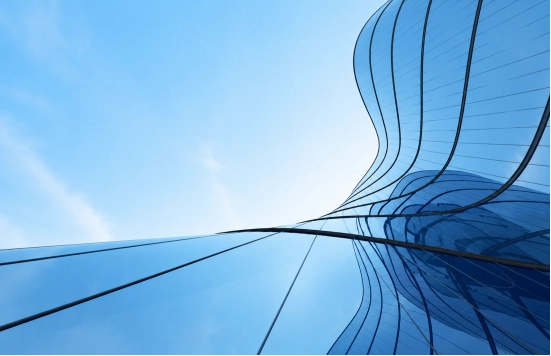
Curved glass for atrium facades can give an entrance one continuous sweep. Yet “make it to this radius” leaves too much open. The tender has to tell the glassmaker exactly what will meet the waiting frame.
What Is Curved Glass for Atrium Facades?
Cold bending holds an originally flat pane under stress to keep a curve. Release it and it wants to spring back. Heat-bent glass has a permanent curve formed during hot processing. For curved architectural glass, agree the method with the support designer.
Why Specify Curved Glass for an Atrium?
I’d choose a true curve when the entrance needs to read as one surface from the pavement. With flat facets, each joint changes the reflection. That can be the look you want; it can also fight the drawing.
The daylight is welcome in a lobby. The afternoon heat may be less so. Give the solar-control design a proper brief around the seats and reception desk, where people actually spend time.
How to Choose the Right Curved Glass Build-Up
Monolithic vs. Laminated Curved Glass
Above lobby doors, do not stop the discussion at “safety glass.” A single lite is monolithic. With curved laminated glass, broken fragments can stick to the interlayer. What matters above an occupied route is whether the damaged panel stays in the opening until it can be replaced. Its supports have a say in that. Ask the engineer to check the construction against this requirement and local rules.
Curved Insulated Glass Units (IGUs)
Curved insulated glass units bring insulation into an enclosed facade. The bending proposal has to work for the whole unit, right through to its spacer and perimeter seals.
Glass Appearance and Coatings
Hold samples against the proposed frame colour before choosing clear or ultra-clear. Tint is another option. For Low-E, settle the coating position and whether the chosen coating can tolerate the intended processing.
How to Specify Curved Glass for Atrium Facades: 6 Key Parameters
5.1 Radius and Curvature
A 30° panel on a 3,000 mm radius needs two labelled dimensions:
Arc length: approximately 1,571 mm.
Chord width: approximately 1,553 mm.
That is 18 mm between two legitimate measurements. Mark the reference surface and bending direction. A non-circular profile also needs a model.
5.2 Panel Dimensions and Tolerances
There is a reason to agree glazing clearances before ordering. Curvature variation uses up some of that room. A large corner panel may be the piece that holds up a quote. Have that size checked against the radius early. Show thickness alongside width and height in the schedule.
5.3 Safety and Structural Performance
“12 mm toughened” looks precise on a purchase order. It still leaves the load calculation unanswered. Put the engineer’s wind loads beside the support arrangement and spans. Building height matters too. Once those checks are done, settle vidrio templado versus heat-strengthened plies and any lamination. Record the safety standard and heat-soak requirement.
5.4 Thermal, Solar and Acoustic Requirements
Two offers may look interchangeable until you notice that only one includes the frame in its thermal figures. Get U-value and SHGC (or g-value) quoted for the same assembly. Include an acoustic target if the lobby faces a noisy road.
5.5 Edgework, Holes and Fixings
A fixing moved late in the job can mean a replacement panel. Once toughened, the glass cannot be drilled or notched. Draw those features from agreed datums, including edge finishes. Supply connection sections so the frame fit and sealant compatibility get checked too.
5.6 Optical Quality and Visual Consistency
Stand on both sides of a two-panel mock-up before signing it off. Looking out from reception and looking at the reflected street are different tests. Agree how far away the viewer stands and what counts as acceptable distortion or colour variation after heat treatment.
Manufacturing, Mock-Ups, and Quality Control
Visitors move around the doorway. A full-size mock-up lets the team check it at the distances visitors will actually stand. Use the intended frame. A loose sample cannot tell you how the joints will look.
Sign off the shop drawings before the batch runs. The approved sample gives production inspections a visual reference alongside measured curvature and edge checks. Ask for traceable records and relevant test reports.
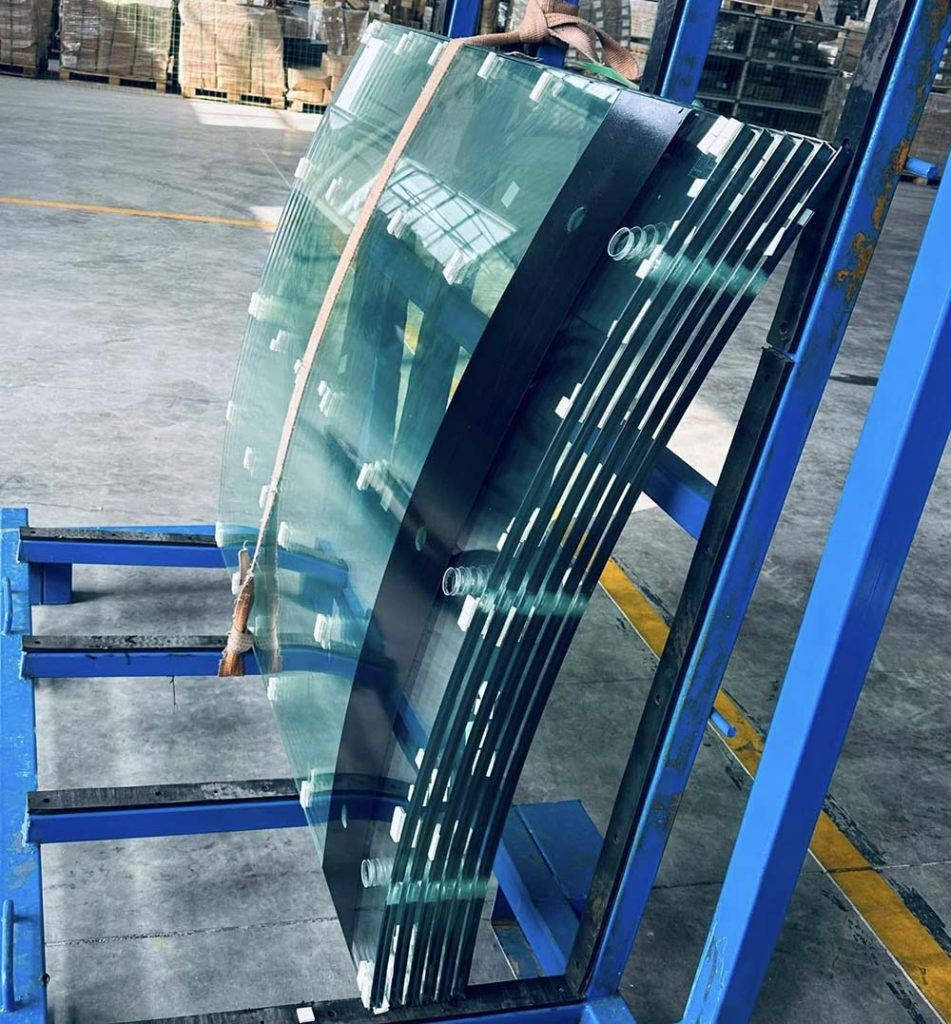
Packing deserves a drawing as well. A curved panel has to survive the sea journey and come off the rack safely, in an order the site crew can use.
Common Specification Mistakes to Avoid
“Same thickness as the last job” is no specification. Nor is a radius scribbled onto an elevation without processing details.
Two other traps sit further down the order: a coating chosen without checking bending compatibility, and tolerances nobody agreed with the frame supplier. Both can escape notice until installation. Missing destination certification can stop procurement even earlier. Settle that scope before treating two quotations as comparable.
What to Send a Curved Glass Manufacturer Before Requesting a Quote
A useful enquiry package includes:
Architectural drawings and available shop drawings.
Radius and arc angle, with panel dimensions.
Proposed build-up and engineered thickness, if available.
Wind loads and required safety performance.
Thermal targets and any acoustic requirement.
Coating and colour choices, with processing details.
Destination standards and required certification.
Quantities and delivery location, with the installation schedule.
It is fine to mark an item “to be confirmed.” Send what you have; we can work through the gaps with you. On the quantity schedule, distinguish repeated panels from pieces that need individual drawings.
Why Work with Landson Glass for Custom Architectural Glass?
Send us the proposed curve while there is room to adjust it. We can discuss the glass construction against the drawings and your destination requirements.
Nuestra StandardsMark-certified curved plain toughened laminated glass includes 10–24 mm constructions in clear and ultra-clear, with green and grey options. That is a defined product scope. Your particular order still needs its build-up and market requirements checked.
Preguntas frecuentes
Q1. What Type of Glass Is Best for an Atrium Facade?
Glazing above a busy doorway may need a different breakage-retention strategy from vertical infill. Supports and thermal targets matter too; get the assembly checked.
Q2. Can Curved Glass Be Made into Insulated Glass Units?
It can, but start with your drawings. The curve has implications for the edge seals and spacer as well as the glass panes.
Q3. What Information Is Needed to Specify Curved Glass?
Dimension the curve and panels. Add the proposed construction with load requirements, then set out performance targets and the relevant fixing details and standards.
Q4. How Do I Request a Quote for Custom Curved Glass?
Include a panel schedule with the drawings and tell us the destination. If the date is fixed, put it in the enquiry alongside the performance brief.
Conclusion: Specify Curved Glass with Confidence
Agree what the glass has to do and how it will fit before releasing an order. Send us your atrium drawings with open points marked so we can review feasibility and quote.