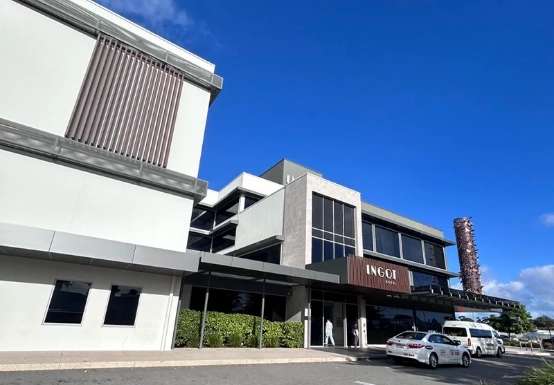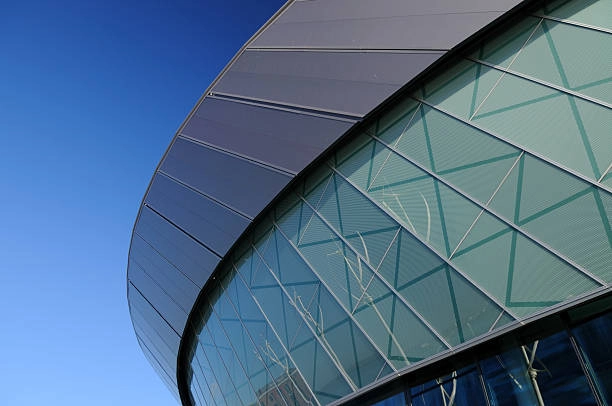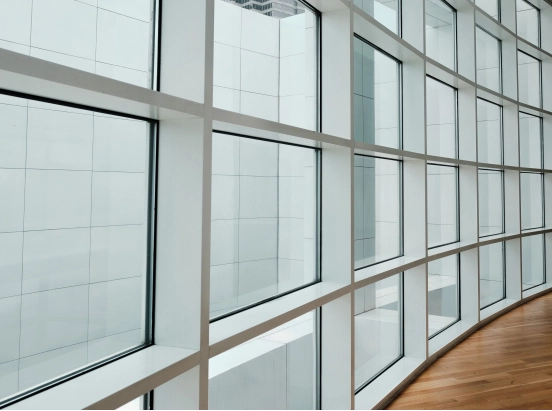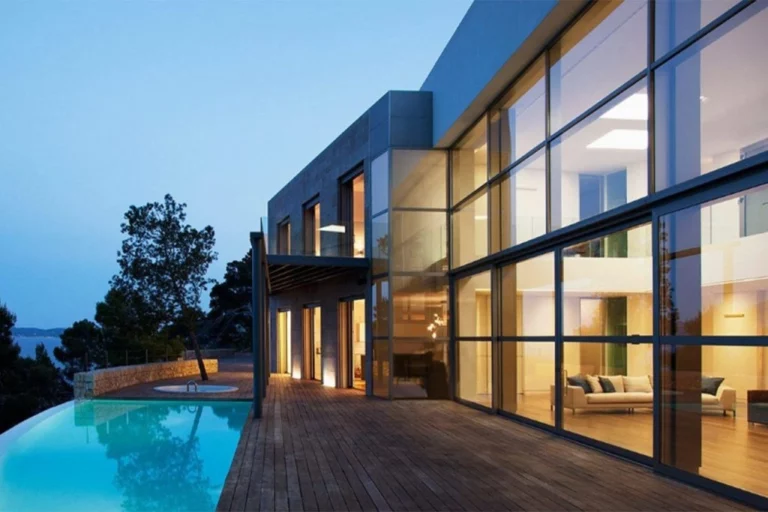


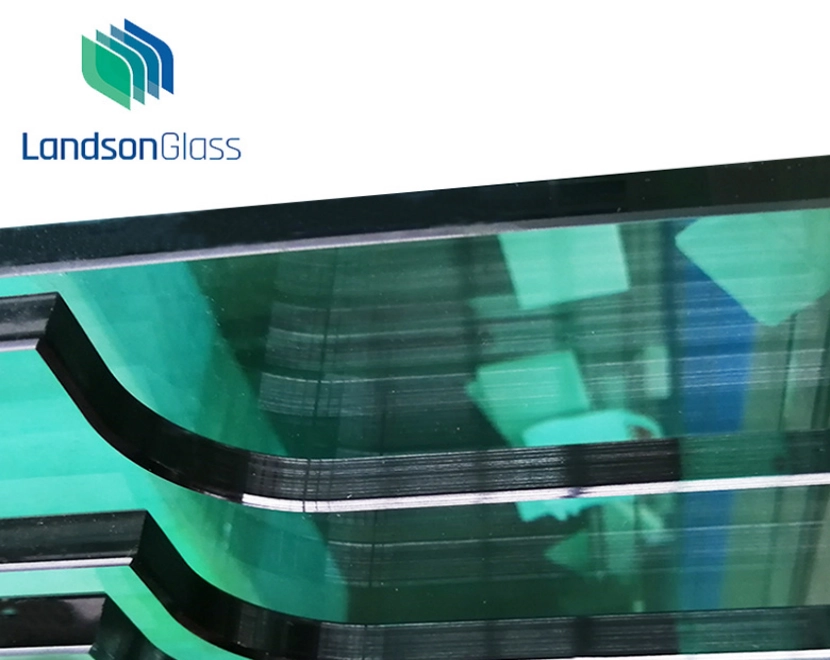
A façade panel may follow a curved entrance, wrap around a column or align with an irregular steel frame.
These details look minor on a drawing. In production, they determine whether the glass can be tempered safely, installed without adjustment and replaced later without changing the surrounding system.
Custom tempered glass should therefore be treated as an engineered component, not a sheet of glass that can be modified on site.
What Is Custom Tempered Glass, and Why Is It Used for Railings and Facades?
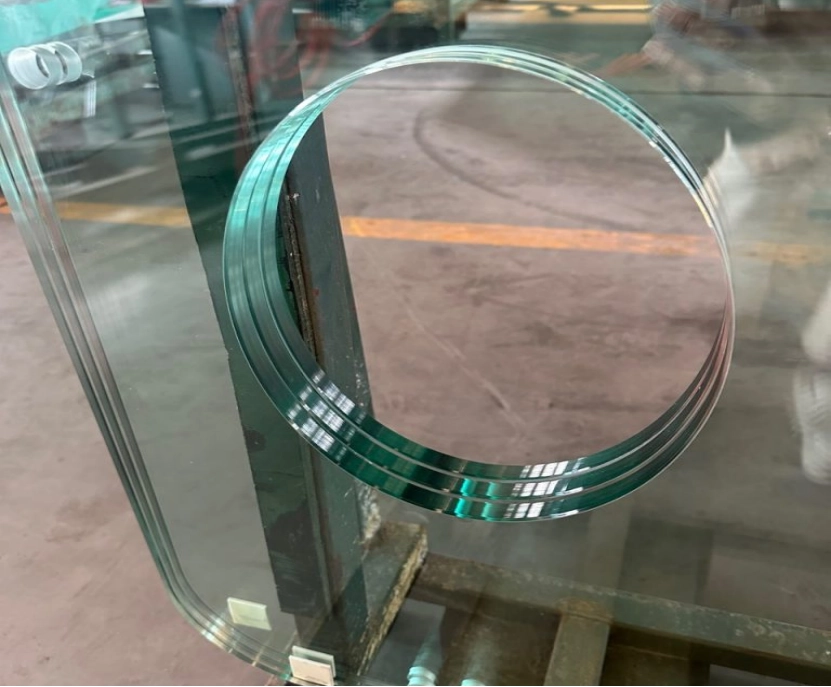
Customization may include drilled holes, notches, internal cutouts, polished edges, rounded corners, sloping sides and curved profiles.
In railing projects, these features allow the glass to connect with standoffs, clamps, base shoes and handrail fittings. In façades, they help panels follow structural grids, steel supports and non-standard building elevations.
How Are Holes and Cutouts Made in Tempered Glass?
Holes and cutouts are normally produced with CNC drilling, milling or waterjet equipment. The exact method depends on the shape, glass thickness, edge condition and required tolerance.
The critical point is timing. All mechanical processing must be planned before tempering.
Why Must Machining Be Completed Before Tempering?
Tempered glass contains a controlled stress pattern. The surfaces are in compression, while the inner section is under tension. This is what gives the glass its increased mechanical strength and characteristic fragmentation pattern.
Drilling or cutting after tempering disturbs that stress balance. The result is usually immediate breakage across the entire panel.
A typical production sequence is:
- Cutting the raw glass to size
- Drilling holes and machining notches
- Grinding and polishing the edges
- Washing and inspecting the panel
- Tempering the finished shape
This sequence leaves little room for late design changes. A site team cannot decide to add another fixing hole after delivery. A new panel has to be produced.
What Affects Hole and Cutout Design?
Hole design is not only about diameter. Edge distance, spacing, hardware load and glass thickness all matter.
A large hole placed too close to a corner creates a weak zone. Two holes positioned too closely can produce a narrow glass bridge that is difficult to temper reliably. Sharp internal corners are also undesirable because stress concentrates at the corner tip.
A common railing detail illustrates the issue. The drawing shows a rectangular notch around a steel bracket, but the bracket has almost no installation clearance. The glass may match the nominal dimensions and still fail to fit because the steelwork is slightly out of position. A sensible radius and practical tolerance would have avoided the problem.
What Shapes Can Be Produced in Custom Tempered Glass?
Modern processing equipment can produce triangles, trapezoids, circles, sloped panels, stepped edges and complex irregular outlines. Internal openings and shaped notches are also possible when the geometry allows safe processing and tempering.
The limitation is usually not whether the machine can follow the drawing. The real question is whether the finished shape can survive handling, heating, quenching and installation.
Long narrow projections are fragile. Deep notches reduce the effective section of the panel. Tight internal corners create stress concentration. Thin glass with several large cutouts may look acceptable in CAD but behave poorly in production.
Edge quality deserves attention as well. Exposed railing edges are normally flat polished or pencil polished, depending on the design. Corners should be arrised or rounded so they are safer to handle and less vulnerable to impact.
An integrated processor such as Landson Glass can complete CNC shaping, waterjet cutting, drilling, edgework and tempering within one production workflow. That reduces the risk of dimensions changing between separate subcontractors.
How Is Curved Tempered Glass Made?
Curved glass requires more information than a flat panel. A note saying “bent glass” is not enough. The fabricator needs to know exactly which surface, radius and direction control the finished geometry.
The forming method also affects what can be achieved.
What Is Bent Tempered Glass?
Bent tempered glass is heated until it becomes soft enough to form. It is then shaped to a defined radius and rapidly cooled while held in the curved position.
This is not the same as forcing a flat panel into a curved frame. Some thin glass can flex slightly, but architectural railing and façade panels should not depend on uncontrolled site bending.
Bent tempered glass is often used for curved balconies, spiral staircases, entrance canopies and rounded façade corners. It can also be laminated after tempering when the project requires post-breakage retention.
What Information Defines a Curved Panel?
A curved glass drawing should state:
- Inside or outside radius
- Arc length or chord length
- Panel height and glass thickness
- Bending direction
- Straight extensions at each end
- Hole and cutout positions
- Required edge finish
- Dimensional and visual tolerances
Hole locations should be defined relative to stable reference points. Measuring only along a curve can create confusion between the drawing, production equipment and site installation.
Hardware selection should also be confirmed early. A fitting designed for flat glass may not sit correctly on a curved surface.
How Do Glass Requirements Differ Between Railings and Facades?
Railings and façades may use similar glass processing, but the design priorities are different.
| Design Factor | Railing Glass | Facade Glass |
| Main concern | Impact resistance and barrier safety | Wind load, weather exposure and appearance |
| Common processing | Holes, notches and polished exposed edges | Large sizes, shaped panels and structural fixing holes |
| Visual focus | Edge finish and hardware alignment | Flatness, reflection and panel-to-panel consistency |
| Typical build-up | Tempered laminated glass | Tempered, heat-strengthened, laminated or insulated glass |
| Additional issue | Glass retention after breakage | Optical quality and spontaneous breakage risk |
Railing glass is frequently touched, viewed at close range and exposed along its edges. Poor polishing, chipped corners or misaligned fittings are easy to notice.
Façade glass is judged across a much larger surface. Reflection quality, roller wave, colour consistency and alignment between adjacent panels may matter more than a small edge detail hidden inside the framing system.
Single tempered glass is not automatically suitable for every application. The final build-up should follow structural calculations, project specifications and local safety requirements.
What Should Buyers Include in a Custom Glass Drawing or RFQ?
A useful RFQ allows the factory to check manufacturability before pricing. It should include panel dimensions, glass thickness, quantities, hole coordinates, cutout radii, edge finishes and applicable standards.
CAD or DXF files are preferable for complex shapes. PDF drawings should still include clear dimensions and reference points. Site photos can help explain the application, but they should not replace proper drawings.
Each panel type needs a unique mark. That mark should appear on the drawing, production label and packing list. This becomes important on projects with dozens of similar panels that differ by only one hole or one sloping edge.
For curved glass, include the radius, chord, arc, bending direction and straight sections. For railing glass, confirm the exact hardware model. “Standard standoff” is not a specification.
How Can Buyers Evaluate a Custom Tempered Glass Supplier?
The supplier should be able to review more than the glass size. A competent processor will question weak notch geometry, unrealistic tolerances and holes placed too close to edges.
Check whether drilling, CNC shaping, waterjet cutting, edge polishing and tempering are handled internally. Ask how curved panels are inspected. For laminated or insulated units, confirm whether later processing is completed under the same quality system.
Packaging also matters. A technically correct panel can still arrive with edge damage if it is loaded badly. Export projects need panel identification, stable timber cases and a packing sequence that matches the installation schedule.
Landson Glass works with overseas railing, façade and architectural glazing orders, where drawing review and coordinated processing are usually more valuable than a low unit price alone.
FAQ
Q: Can holes be drilled in glass after tempering?
No. Drilling or cutting tempered glass will normally cause the panel to break. All holes, notches and cutouts must be completed before tempering.
Q: Can every irregular glass shape be tempered?
No. Very narrow sections, deep notches, sharp internal corners and large cutouts may create unacceptable stress. The shape should be reviewed by the fabricator before production.
Q: Is curved tempered glass suitable for railings?
Yes, provided the glass thickness, radius, fixing method and laminate construction meet the structural and safety requirements of the project.
Q: Should railing glass be laminated?
Tempered laminated glass is commonly used because the interlayer can retain broken fragments. The required construction depends on the railing system, design load and local building code.
Q: Why is a sample panel useful?
A sample or first-off panel helps confirm hole positions, edge quality, curvature and hardware fit before the full production batch is released.