

How Should Bird-Friendly Glass Be Specified?
Bird-friendly glass should use a visible pattern with tightly controlled open spaces, positioned where birds can detect it and applied across the facade’s collision-risk zones. For many projects, a pattern with no more than 2 in. (about 50 mm) of clear space in either direction is a practical starting point. It is not a universal code: the governing ordinance, approved product criteria and project ecologist or facade consultant must define the final requirement.
The objective is to interrupt reflected habitat and apparent fly-through routes. A pattern that looks effective on a white sample board may disappear against reflected sky, trees or interior planting, so spacing, contrast, surface position and the complete glass build-up must be reviewed together.
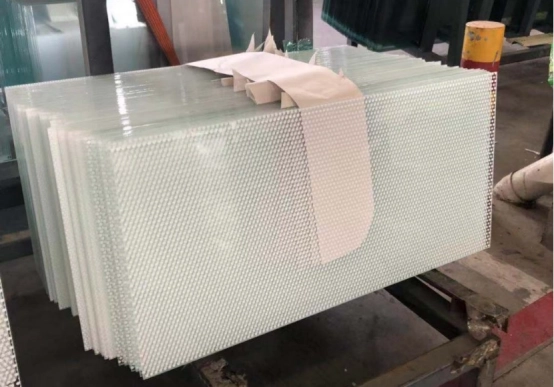
Start with the 2 X 2 Pattern Rule
The 2 x 2 concept used in American Bird Conservancy guidance limits unobstructed gaps to approximately 2 in. horizontally and vertically. This tighter grid has become a conservative design reference because it reduces openings that a bird may perceive as a flight path. Older guidance may refer to a 2 x 4 rule. Do not assume that the wider vertical gap is accepted by the authority reviewing a current project.
On drawings, dimension the clear gap between marker edges, not only the center-to-center pitch. For example, 6 mm dots at 50 mm centers leave a 44 mm clear gap. The same dots at 56 mm centers leave 50 mm. This distinction prevents an artwork revision from unintentionally opening the pattern.
| Pattern | Useful Application | Main Control |
| Dots | Repetitive curtain-wall modules | Dot diameter and clear gaps in both axes |
| Lines | Facades with a strong directional language | Clear gap perpendicular to each line |
| Custom graphics | Feature elevations and branded areas | Every open area, not average coverage |
| Gradient | Privacy or solar shading transitions | The sparsest zone must still comply |
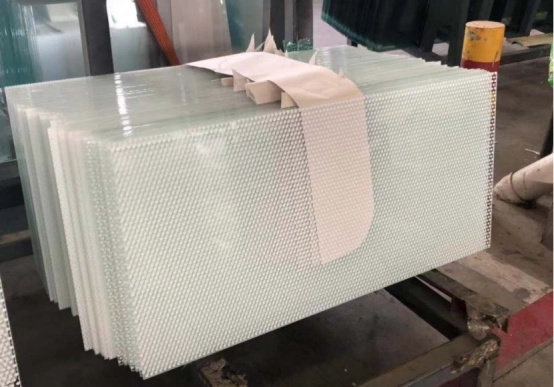
Landson Glass’s ceramic frit glass options support repeatable geometric patterns, while custom digital printing suits more complex artwork. Neither process is automatically bird-friendly; the approved geometry and visibility determine whether the design meets the project criteria.
Place the Pattern Where Birds Can See It
Markers are generally easiest for birds to detect when they are on the exterior, bird-facing surface, commonly called surface #1. If the pattern is behind the outer lite, exterior reflections may partly mask it. That does not mean every project must use surface #1: tested assemblies, local codes, durability, cleaning access and coating compatibility can require a different construction.
The glass schedule should therefore state the numbered surface, not merely “outside” or “inside.” It should also identify the view direction and pattern orientation. These details matter at corners and on mirrored elevations, where a correct pattern can still be installed or produced in the wrong orientation.
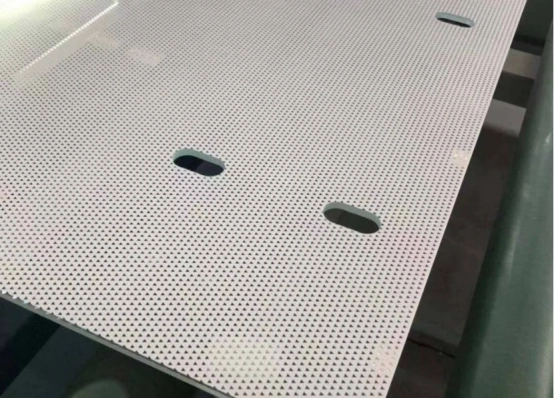
Apply Treatment to the Right Facade Zones
Do not define the treatment area by floor level alone. Review each elevation for conditions that create reflected habitat or a transparent route. Priority locations commonly include:
- Glass opposite trees, planted roofs, water or landscaped courtyards
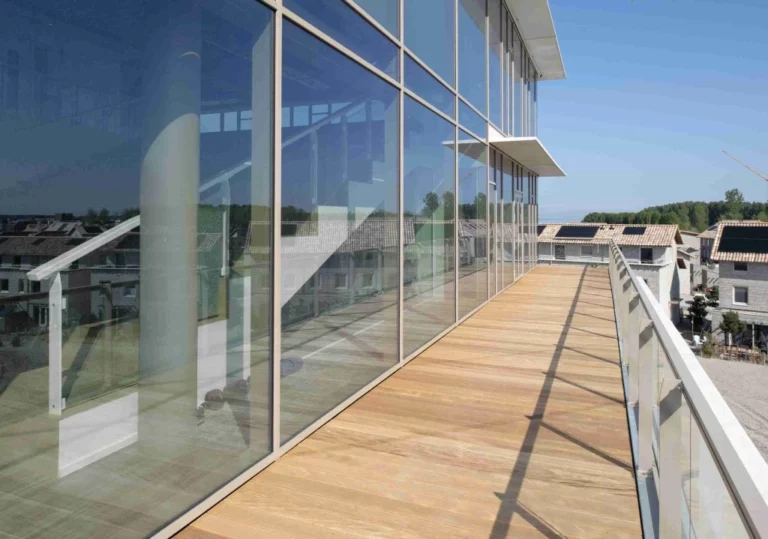
- Transparent corners, link bridges and glass corridors
- Atriums, lobbies and entrances with a view through to exterior vegetation
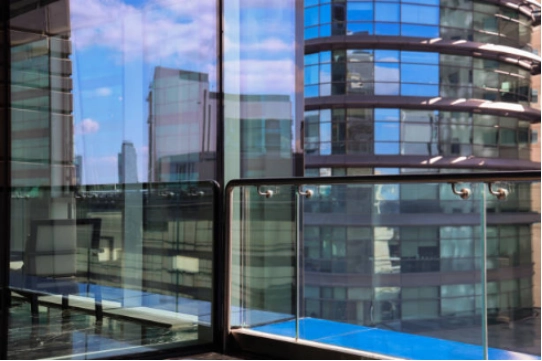
- Balustrades, wind screens and freestanding glass barriers
- Recessed facades where shade makes interior planting visible
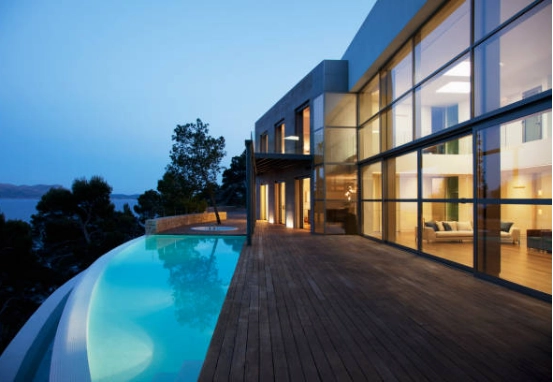
- Night-lit interiors where the project also has a lighting-control requirement
Codes differ in treatment height, percentage and definitions of hazardous features. Some also set a maximum threat factor or require an approved product. Mark treated areas on the elevations and glass schedule, then reconcile them with the authority’s rule and the project’s ecological review. A blanket note such as “bird-safe frit where required” is not production information.
Coordinate Frit with the Glass Build-Up
Bird visibility is only one part of the specification. The pattern must be coordinated with heat strengthening or tempering, lamination, the insulating cavity, Low-E coatings, edge deletion, sealants and thermal-stress analysis. Landson Glass supplies insulated glass unit options, but the project team must define the required thermal, structural, safety and optical performance of the final assembly.
For an IGU, identify all surfaces from exterior to interior and locate both the frit and Low-E coating. Confirm that the proposed surfaces are compatible and that the print will not interfere with edge seals or required deletions. For laminated glass, check the print’s relationship to the interlayer and the intended exposed face. Bird-friendly treatment does not by itself demonstrate impact safety, post-breakage behavior, U-factor, SHGC or wind-load resistance.
Landson Glass’s guide to high-rise curtain-wall glass configurations provides related context for selecting the complete make-up rather than treating frit as an isolated finish.
Use a Submittal and Mock-Up Checklist
Before pricing or production, record the following information in the glass schedule, artwork and specification:
- Marker shape, dimensions, color and opacity
- Maximum horizontal and vertical clear gaps
- Pattern origin, repeat, edge offsets and orientation
- Glass surface number and exterior viewing direction
- Treated elevations, zones and panel references
- Glass type, thickness, heat treatment and overall make-up
- Coating, interlayer, edge-seal and sealant requirements
- Dimensional, registration and color tolerances
- Governing code, required rating and supporting test evidence
- Sample size, full-size mock-up and approval criteria
Review a full-size mock-up from outside at realistic distances and angles, under bright and overcast conditions where possible. Inspect the clear gaps, contrast, registration, color, orientation and transitions between panels. Record the approved sample and artwork revision. A small hand sample can confirm color and print quality, but it cannot reproduce facade reflections or module-to-module continuity.
FAQ
These questions address common decisions that remain after the pattern concept has been selected.
Is the 2 X 4 Rule Still Enough?
Not for every project. Many current programs favor gaps no greater than 2 in. in both directions. Confirm the applicable ordinance, rating system and approved assembly before fixing the artwork.
Does Every Ceramic Frit Pattern Qualify As Bird-Friendly?
No. Ceramic durability does not establish bird deterrence. Marker size, clear spacing, contrast, surface position and any required test rating must all meet the project criteria.
Can Bird-Friendly Frit Be Combined with Low-E Glass?
Often, yes. The supplier and facade consultant must coordinate the frit and coating surfaces, heat treatment, edge conditions, color appearance and compatibility within the final make-up.
Are Gradient Patterns Acceptable?
They can be, but the sparsest part of the gradient must still satisfy the required maximum gaps and visibility criteria. Average pattern coverage can conceal a noncompliant open zone.
Should the Mock-Up Be Reviewed Indoors or Outdoors?
Review it outdoors in representative light and against realistic reflections. Indoor inspection remains useful for print quality, color, pinholes and registration, so both views serve different purposes.
Request a Bird-Friendly Glass Review
For a production-feasibility and quotation review, contact Landson Glass with the elevations, panel dimensions, glass make-up, pattern artwork, surface location, performance requirements, governing criteria and mock-up plan. Early coordination helps turn a visual concept into an unambiguous glass schedule.